Manomet, Plymouth, Massachusetts, USA

Manomet, Plymouth, Massachusetts, USA

Monday, June 10, 2013

Simes House, Manomet, Plymouth, Massachusetts, USA

The restoration of the Simes House, which began in August 2012, is moving ever closer to completion. The Simes House was built in about 1863 and was in need of tender loving care and repair and restoration. The Simes House Foundation was created to restore and maintain the Simes House and Manomet Commons as self-sustaining historical landmarks in the Village of Manomet. For the public benefit, the Foundation will enhance cultural focus and identity, provide education and encourage community service. 

Manomet is one of the villages of Plymouth, Massachusetts. It is a seaside village south of downtown Plymouth and adjacent to White Horse, Priscilla, and Manomet beaches. Plymouth itself is the largest municipality by area in the state and boasts at least 365 lakes and ponds within its borders - one for every day of the year. 


Back in August 2012, the restoration project was just beginning.  


Saturday, June 8, 2013

A New England Cottage in Spring, Bartlett Pond, Manomet, Plymouth, Massachusetts, USA

What a difference a season makes - after the browns and grays of winter, life is bursting out on this fine spring day in New England. (Panorama - click on the image to view in full width).

Small cottages like this one dot the landscape in New England with many located on any of the thousands of freshwater ponds and lakes throughout the region.  The cottages, or "camps" as they are often called, are usually small and often funky. Many of the area's kids, whose parents or families were fortunate enough to have such a place, will carry life-long fond memories of swimming, boating, playing, and lazing away many a warm summer's day in an idyllic setting. 

A close-up of one of the rhododendron blossoms beside the cottage.

Bartlett Pond (Panorama - click on the image to view in full width).

It's astounding how fast spring gets going once it gets going.

The brown and gray version from two months ago when spring was just an idea.

Friday, June 7, 2013

The Dandelion, Manomet, Plymouth, Massachusetts, USA

Often disparaged and called a "weed," the humble dandelion is a delicate and beautiful flower.


Long valued as a food and herb (and wine) throughout the world, it is mostly the crazed, obsessed, green-grass-lawn crazies in North America that try to kill it with poison chemicals.  Why do we do that?

Thursday, June 6, 2013

My Garden Revisited - the 2nd "Crop," Manomet, Plymouth, Massachusetts, USA

I have returned home after my trip to New Mexico and am pleased to see that my second "crop" of the season is thriving.  The first "crop" of dandelions have given way to tens of thousands of  little clover heads.

They are much more interesting than plain old green grass - and no nasty chemicals need to be poured on the soil - just rainwater and sunshine - I like that - and so do the bees.


Wednesday, June 5, 2013

Goodbye Albuquerque - Flying from ABQ to ORD, Albuquerque, New Mexico, USA

 The arid desert climate of Albuquerque, New Mexico, briefly gives way to some cropland and the green of the cottonwoods that line the Rio Grande south of town.  I am flying from the Albuquerque International Sunport in Albuquerque, enroute to Chicago O'Hare airport in Illinois on my way back to Boston, Massachusetts. I don't normally sit in a window seat because the curvature of the fuselage doesn't give me enough headroom - I prefer the aisle.  This was one of those regional jets with only one seat on my side of the aisle so I got to see out the window.  What a treat! 

This suburban residential area just to the west of the river exhibits a distinct lack of flora. The desert rainfall here averages about 9 inches a year and doesn't create much visible flora.

The flight continues over northern New Mexico and southern Colorado - I am struck by this perfectly straight segment of road in the desert 30,000 feet below  ( I colored it in with gray to make it more visible in the photo). My first surprise was, "why is that one segment so straight?" My second surprise was, "why is there a road there in the first place?"  

The desert areas gave way to the Rocky Mountains and in this image I cross the last snow-streaked peaks south of and approaching the Denver area. This is the most eastward escarpment of the Rockies - from here, the upper midwest begins to stretch eastward and tends toward flat farmland.

East of the Rockies, the air mass over the upper midwest states of Nebraska, Iowa, and Illinois, has been breeding daily huge thunderstorms and occasional tornadoes.  The cumulus clouds start out gently enough but.....

.....grow and grow and grow........

.....until they explode skyward and create the anvil shaped head, one of the visual manifestations of a thunderstorm. The pilot bobbed and weaved us through the towering field of these building giants.  The white haired man in the seat in front of me ordered and drank two vodkas and a Bailey's.  I'm not sure if he was nervous or just felt like getting hammered. It was bumpy but not that bad.

As I approach the Chicago suburbs on descent to landing, the difference between a location with 9 inches of rain annually like Albuquerque and 36 inches of rain is glaringly obvious. Chicago, 1400 miles northeast of my starting point in Albuquerque,  is another world by comparison.

 The presence of  visible lightning on the airport from a nearby thunderstorm required all ramp personnel to move into shelter so we taxied in long ovals for a while before we could park and unload - a long while.  The airport's schedule had been dealt a serious blow by the weather - many flights were canceled and thousands of passengers had their travel plan disrupted to varying degrees.  My next flight segment got canceled and so did the next two scheduled.  I eventually got to Boston at 3:45am the next morning - and that's not a complaint -  I got there safe and sound, always the preferred outcome.  Air transportation continues to be a magical and remarkable capability of our modern age, but, nature still has the final say in safety - and that's as it should be.  So many people and so much technical equipment work together in an extraordinary way to produce such a great air transportation system, it reminds me what a pleasure it was to spend my professional career involved daily with many of the men and women who make it all work safely every day.


Tuesday, June 4, 2013

A Walk in the Rio Grande Valley State Park, Albuquerque, New Mexico, USA

The Rio Grande Valley State Park winds through the city of Albuquerque along the Rio Grande.  The park's 4000+ acres features a cottonwood forest along the river and a 16 mile paved pedestrian and bicycle trail.  The trees tower over hikers on this warm spring day.


Notwithstanding the severe drought in the area (see this link for the current official U.S. Drought Monitor), the river itself was full of water, compliments of spring runoff from the mountains to the north and controlled and managed releases.

A very pleasant and peaceful place for a nice flat walk.


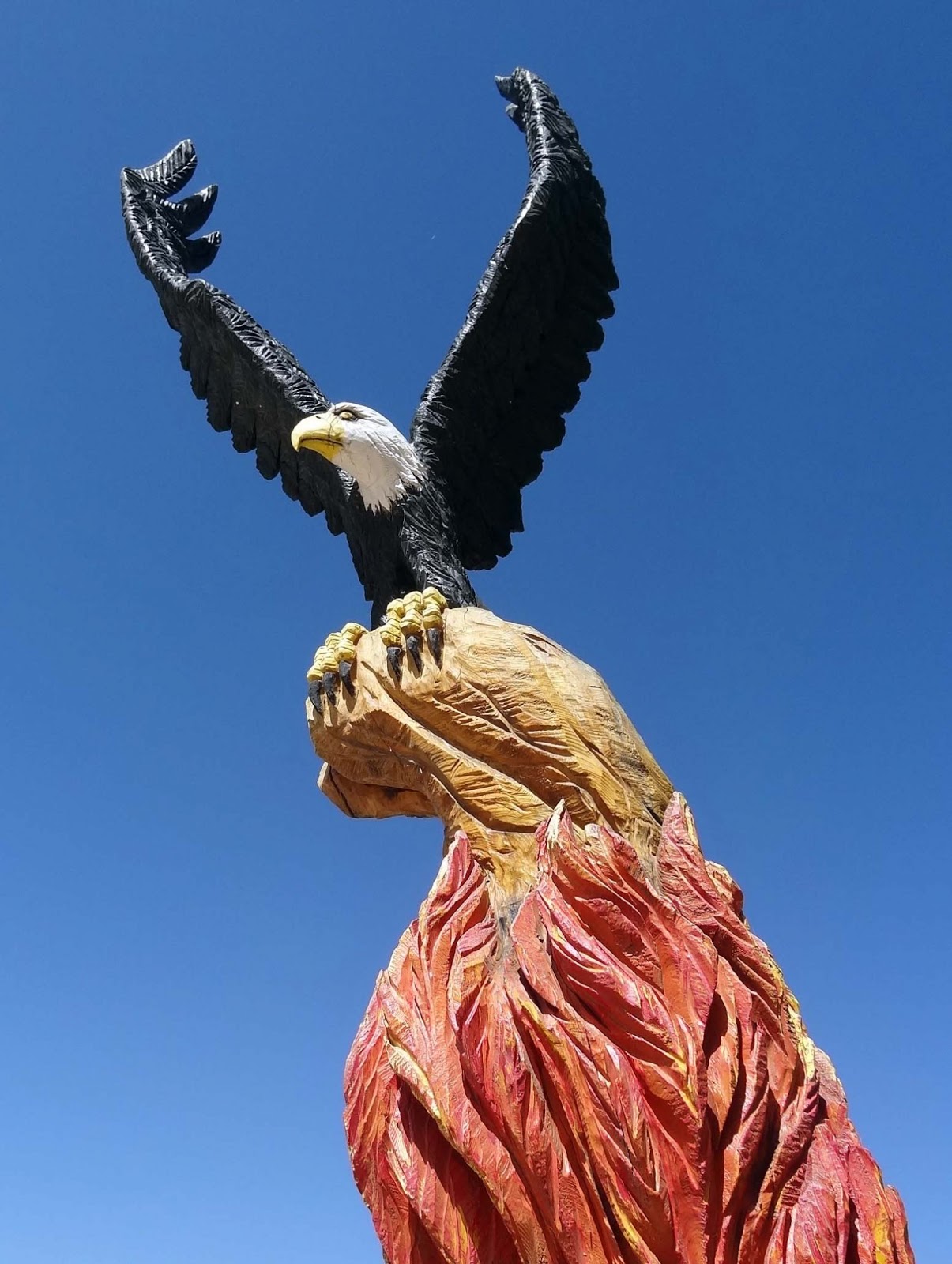
Instead of cutting down these large dead trees near an automobile parking access area, some were turned into sculptures.


Monday, June 3, 2013

Sunset in the Sandia Mountains, Albuquerque, New Mexico, USA

The temperature drops, the shadows lengthen, and another day slowly draws to a close on top of this 10,300 foot peak in the Sandia mountains.  (Panoramic image - click it to view in full width).  "Sandia" means "watermelon" in Spanish and likely refers to the color of the  mountain in sunset light as viewed from the valley below.

The sun has set in the valley but the last rays of red-orange still tint the rocks on the mountaintop.

The final rays peek out above the horizon.  (Panoramic image - click on it to view in full width).

The mountain isn't the only thing that turns a bright red-orange color in the setting sun.

The lights in the town of Albuquerque become more visible as the last vestiges of daylight fade from the sky above.


Sunday, June 2, 2013

Sandia Tramway, Albuquerque, New Mexico, USA

No matter where you find yourself in Albuquerque, towering in the background is always the majestic range of the Sandia Mountains.  The best way to visit and enjoy the 10,300 foot high mountain is to ride the tram to the top.

The very stable 2.7-mile ride, 15-20 minutes or so, affords quite a nice view on the way up and down. Tourists in the summer, tourists and skiers in the winter - and a nice restaurant at the top if you are so inclined.


Whether young or young at heart it's a pleasant ride.

The canyons that concentrate the occasional rain serve as vibrant habitat within this harsh landscape.

It may be harsh but it is extraordinarily beautiful.

The Rio Grande valley and city of Albuquerque stretch out in the distance as the tram continues its climb.

And at the top, it seemed that just about everyone had a camera of some sort......

.....although operating it might be a challenge sometimes.

Family portraits were popular among the tourists at the top.

It was 51 degrees on top of the mountain after leaving the mid-80's at the bottom. The wind was blowing 20-30 mph.  It gets chilly up there as sunset approaches.


Saturday, June 1, 2013

Blooming Cactus, Albuquerque, New Mexico, USA

The desert is alive with spring growth as many cactus varieties are busting into bloom.

And where the flowers are, the bees aren't far behind.

This little fellow is enjoying an orgy of pollen to take back to his hive. It's no wonder my sinuses are not happy being here this week with all the pollen and dust flying around in the bone dry air here.

This bloom (not a cactus) had some cool red tendrils shooting out. Yep, nothing like this in the northeastern United States.  On the other hand, the northeast has plenty of water and this area is experiencing a severe drought even considering their desert status. You can view the entire US drought conditions at this link: http://droughtmonitor.unl.edu/