Manomet, Plymouth, Massachusetts, USA

Manomet, Plymouth, Massachusetts, USA

Sunday, February 13, 2011

Vejer de la Frontera, Andalusia, Spain

The Andalusia region comprises the southern part of Spain on the Iberian peninsula.  This hilltop "pueblo blanco" in southern Spain, is Vejer de la Frontera. In the far distance is the Strait of Gibraltar and the Mediterranean. The architecture reflects the influence of Moorish rule a thousand years ago. It's a great walking town.

The town center of Vejer de la Frontera.

Around town in Vejer.


The streets of Vejer were designed a thousand years ago for pedestrians or maybe horse and donkey carts - not today's automobiles which barely fit through the tight lanes.

Folks dressed up for the annual fair in Vejer.

A mellow cat just hanging out in Vejer.


The light has a special quality here - clear, bright, fresh - perhaps that is part of the reason why this coastal area of southern Spain is known as the Costa de la Luz (Coast of Light).

Some restaurants welcome other species.

A monastery in Jerez de la Frontera.  Jerez is known as the sherry capital of the world.


A street scene in the town of Rhonda, typical of many villages of southern Spain.

The obligatory family photo in front of the arches of Rhonda.


And in Spring, the hillsides for miles are covered in gold.


Saturday, February 12, 2011

Merrimack, New Hampshire, USA

Here's a refresher for those of you who have forgotten the wonder and fun of driving on slippery roads during a New England snowfall.

The stark contrast and quiet beauty is best enjoyed from an armchair at home - instead of the 10 degrees Fahrenheit early morning shown here.

The same view but in the shadowless morning light. Frankly, I'd rather be where it's warm and sunny.

Like here, for example!

Saturday, January 22, 2011

Medford, Massachusetts, USA

After all that wonderful Ecuadoran warmth less than a week ago, here we are back home after a fresh new half foot of snow - temperature at 9am: a not quite tropical 12 degrees F.  Normally, the Boston area receives about 43 inches of snow during the winter season.  We already have received more than that and the season is not even half way over yet.  Looks like a long winter still ahead but at least the days are already getting longer - the sun doesn't set at 415pm now - Spring is on the way!

Saturday, January 15, 2011

Otavalo, Ecuador

Otavalo has markets every day of the week but on Saturday the place explodes with a bewildering array of goods. Colors are made even brighter by the intensity of the equatorial Andean sunshine.  From rugs and blankets......

........to bags and purses..........

.........to hats.......

.........to unknown street food (which was mighty tasty).....

.........to the most common street food: little plastic bags with corn, chochos, and a tomato onion lime sauce, there is something for everyone.  I guess it's the Ecuadoran version of fast food but it's all healthful and vegetarian (and it sure was tasty also!).  Vendors were everywhere selling it.

Out of thousands of people here, I saw four national police officers milling calmly in their blue camouflage uniforms.  I guess they're blue to blend in with the intensely blue Ecuadoran sky.

A cross-section of Ecuadoran cultures exhibit the Spanish influence, the indigenous Quechua influence, and even the United States influence with the kid in a Hollister hoody.  Otavalo is a town of many markets - the tourist market, the fish market, the animal market, the fruit and vegetable market, the meat/fish/chicken market, the housewares market.  People out in the fresh air and brilliant Andean sunshine buying and selling and visiting and hugging instead of shopping in isolated shops or malls.  They've been doing it this way for hundreds of years and I hope they keep doing it for thousands more.  The land of eternal Spring breeds an attitude of warmth and friendliness among it's people - many here haven't much by "first world" standards, but they seem to be kinder, more helpful, and more caring of each other than many in the "first world." 

  I hope you've enjoyed reading this blog as much as I have enjoyed creating it.  This ends our trip to Ecuador. We head back to Quito today, fly to Miami and Boston tomorrow and wake up Monday with 18 inches of snow to clear away in single digit temperatures - it sure was fun while it lasted!  We'll be back again! Hasta luego.

Otavalo, Ecuador

At 15,100 feet MSL, the summit of Volcan Imbabura is often shrouded in cloud.  We were lucky to get a couple days when the summits of both Imbabura and Volcan Cotacachi (16,200 feet MSL) on the opposite side of the valley were visible.  This photo was from the steps of town hall at Parque Bolivar.

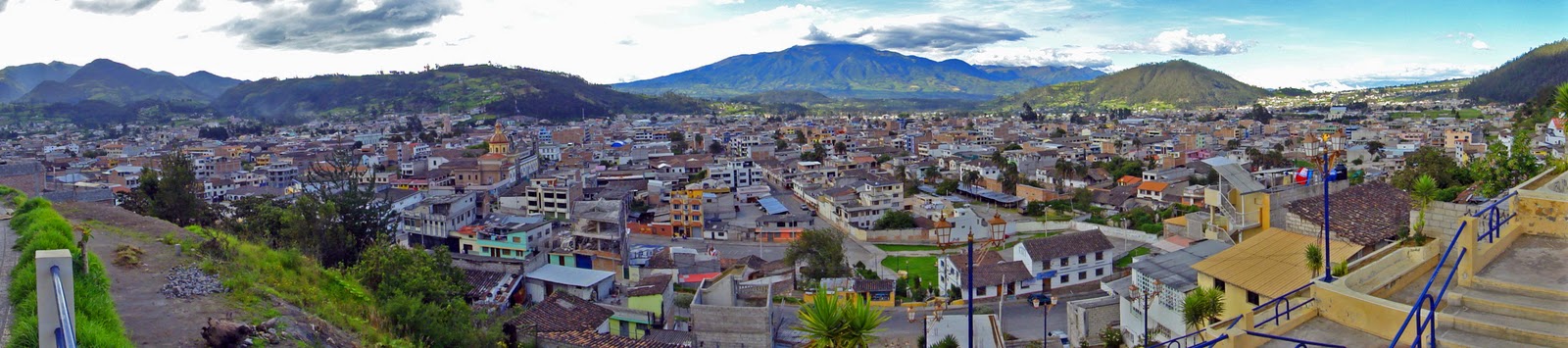
Another attempt at the panorama feature.  The town spreads out in the foreground with Volcan Cotacachi in the distance.


This adornment of the streetlamp is one of many different stained glass creations on streetlamps in the downtown area.

As dawn breaks over the town, Volcan Imbabura towers on the horizon. I assure you that this photo in no way captures the majesty and presence that these mountains inspire when standing there in person.

Morning in Otavalo.

At this particular hole-in-the-wall restaurant the cook stands in the doorway, the diners are seated at the tables in the darkness behind her.  The far end of the pan in which the precooked/smoked pig is lying sits on the gas stove and the cook carves off pieces to order and cooks/heats them on the spot. The "plato del dia" today in this instance is pork with some accompaniment such as rice, salad, chochos, toasted corn, and/or grilled bananas/plantains. We didn't eat here since we're vegans but I'd bet the food was outstanding for the meat eaters who did.

Street vendors include wheeled carts or the guy in the background with a bucket of bread on his head for sale.

Few homes and businesses have any heating or cooling systems installed. With this climate who needs it.  But most everyone cooks with propane.  Here's the propane man wheeling his bicycle cart through town dispensing propane refills where needed. Note the little Chevy in the background - lots of them here.

Amidst the explosion of color at the Plaza de Ponchos market area, we braved the aggressive vendors hawking a wide range of beautiful fabrics, hats, jewelry, and other resident necessities or tourist trinkets. 

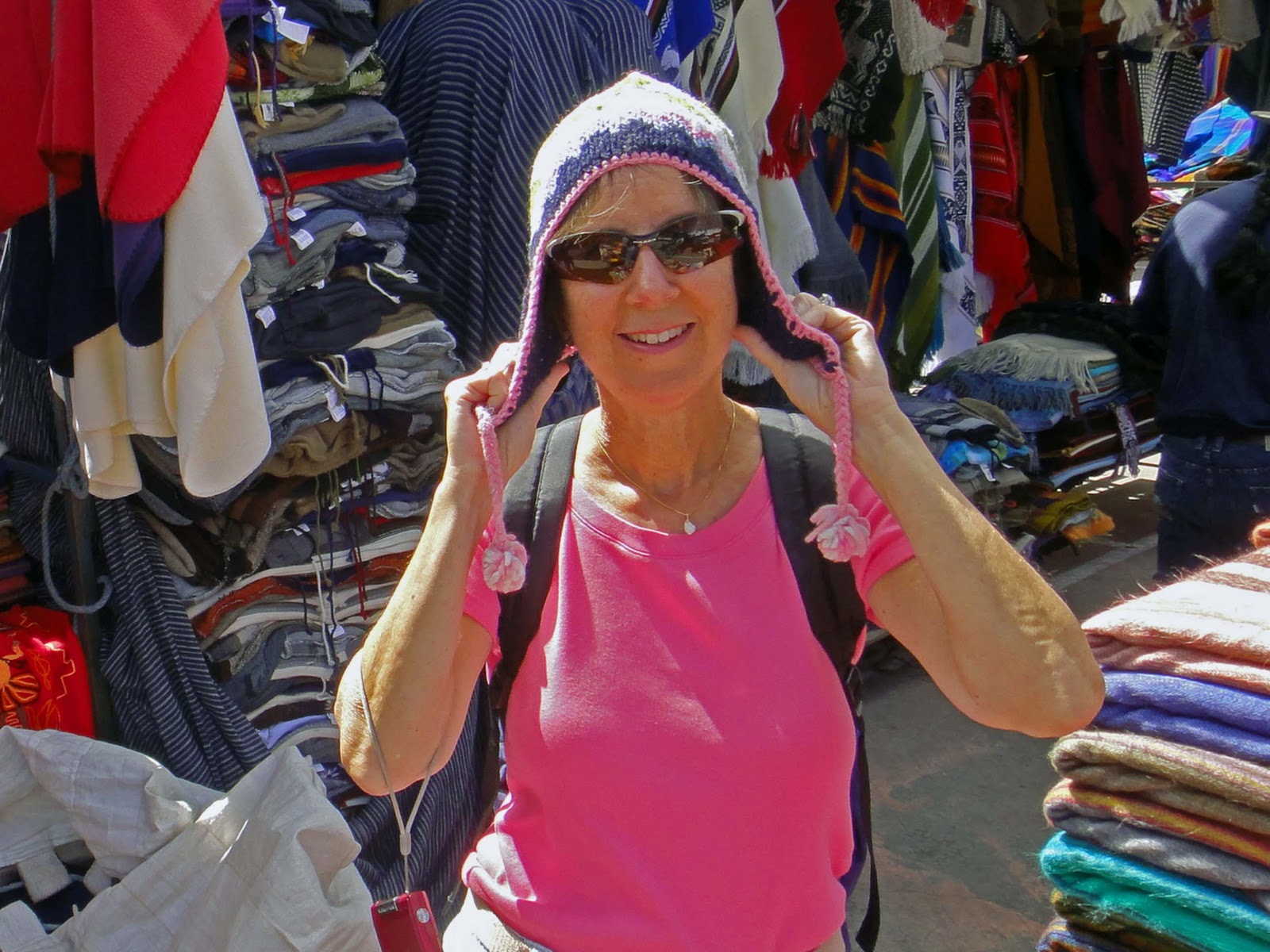
Amy begins her quest for the perfect winter hat.

Is it this one?

Or this one?

Maybe this one?

Meanwhile, on a side street off the market square we stumbled upon the leadership of the secret cabal of finger puppets. There must have been tens of thousands of these little people waiting to take over the world.  I think their leaders were plotting on how to get out of the storage room and into your homes.  Having no legs and no mobility makes it very difficult for them but, they are wily and clever and will no doubt be seen near you very soon as they advance their world domination scheme.  Amy bought quite a few to help sow the seeds of finger puppet domination in North America.

Thursday, January 13, 2011

Cotacachi, Ecuador

Today we traveled via taxi ($5.00) to Cotacachi which is a small town located about 9 miles from Otavalo nestled at the base of Volcan Cotacachi.  Many North Americans have settled here as expats/vacationers/retirees. Here's a pretty young American tourist looking around the town. (Yes, it's Amy).

This scene plays out daily countless times in countless towns throughout Ecuador - buying fresh fruit or vegetables from a hole-in-the-wall vendor. A papaya is $0.25 for example.

A typical street scene.
After walking around town at midday in the hot sun, we decided to splurge on a fancy lunch.We hiked to the La Mirage Resort and Spa on the edge of town and had a lunch fit for a king and queen.

A half dozen of these male peacocks wandered around the grounds outside the window by our table.

We have been to many different restaurants and eating establishments throughout the world over a combined 100+ years of living. But neither of us has ever been served an appetizer in a hand carved music box.  A delicious quinoa croquette greeted us with music when the lid was raised. You just can't make this stuff up - who would have ever thought.......

My ensalada of verduras y fruta con aguacate y oliva de aceituna con limon was outstanding (as was the musical croquette).

Instead of a taxi for the return ride, we opted for a bus back to Otavalo ($0.25 each).  Ecuador has thousands of buses like the one above that criss-cross the country frequently and at very low rates.  Short distances are generally $0.25 per person or, for long distances $1.00 per hour of travel.  This is the transportation life-blood of the nation as few have cars.

The bus will stop almost anywhere along the route where a person is standing and waves to the driver.  The driver will let off anyone anywhere along the route. In addition to the driver there is another person that collects the fares and assists the driver.  It's a remarkably effective and efficient system from my observation.
We passed by this typical building leaving Cotacachi which brings up an interesting point.
This building under construction is typical of building methods observed throughout the country.  Machines are few, labor is cheap, concrete is mixed and poured by hand, scaffolds are made of bamboo,  and most structures have steel reinforced concrete floors and vertical supports and brick to fill in the exterior wall spaces. Even modest homes use these methods. Haven't seen or heard of many wooden "stick-built" homes.